
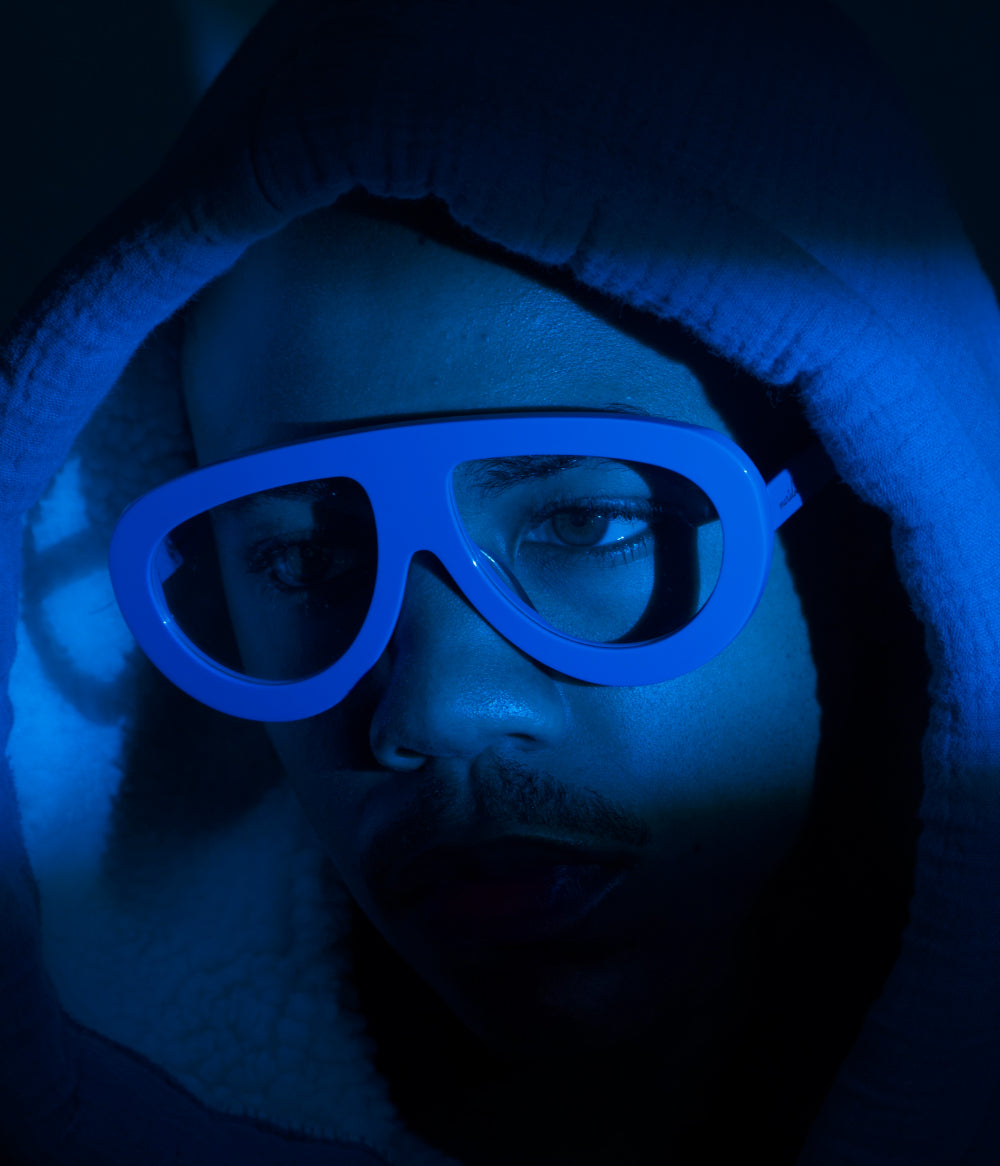
Blue Light Filter Glasses Are Having a Moment. Here's Why I Finally Made My Own.
I spend a lot of time on screens. Designing, sourcing, scrolling, replying to DMs at midnight. If you're anything like me, "screen-free evening" is more of a wish than a reality.
At some point I started waking up with a dull headache more days than not. My eyes felt tired by 3pm. I blamed coffee, posture, general life. Then I started actually paying attention to blue light, and a lot of things clicked.
I looked into blue light glasses for months before I decided to make them. I tried a dozen pairs. I read the studies. I talked to optometrists. I landed somewhere more nuanced than "blue light bad, block it all." Here's what I actually learned, and why it led to the glasses I'm dropping this month.

WHAT BLUE LIGHT ACTUALLY DOES
Blue light is part of the visible light spectrum. Your phone, laptop, LED lights, basically everything you look at indoors emits it. The reason it matters at night is that blue light suppresses melatonin, the hormone your body uses to know it's time to sleep.
During the day, that's mostly fine. Natural sunlight has way more blue light than any screen, and daytime exposure actually helps regulate your circadian rhythm. The problem is evening screen use. When your eyes are taking in blue light at 10pm, your brain gets confused. It thinks it's still daytime. Sleep takes longer, and quality drops.
The eye strain piece is more complicated. Digital eye strain is real, but it comes from a mix of things: screen brightness, how often you blink (which drops a lot when you're focused), distance from the screen, and yes, the light wavelengths hitting your eyes. Blue light filter glasses reduce one of those variables. Not all of them. But it's a meaningful one.
WHY MOST BLUE LIGHT GLASSES BARELY DO ANYTHING
This was the part that surprised me most. A lot of glasses marketed as "blue light blocking" filter maybe 10 to 20 percent. Sometimes less. You can test it yourself: hold a pair up to a blue LED. If blue light passes through clearly, the filter isn't doing much.
Effective lenses should block a meaningful amount in the 400 to 450 nanometer range, which is where blue light has the most biological impact. Some lenses do this with a coating, others with a tint. Tinted ones usually work better but can make your screen look warm or yellow. Not great if you work in design or content and need accurate colors.
I spent a long time finding the balance. The Marieloulou Gnarly lenses filter around 40% in that critical range while keeping color distortion minimal. Your screen still looks like your screen. That was non-negotiable for me.


THE FRAME PROBLEM NOBODY TALKS ABOUT
Blue light glasses only work if you actually wear them. Sounds obvious. But I had three pairs at various points and kept leaving them on my desk. They were fine, just not something I wanted to put on.
Frame design matters more than people admit. If the glasses feel like a medical device or a throwaway accessory, you'll wear them sometimes. If they're something you genuinely like the look of, you'll wear them consistently. That's the difference between a pair you own and a pair that actually helps you.
I designed the Marieloulou Gnarly frames to work as an everyday accessory, not just a screen-time tool. They're meant to go from your desk to a coffee run without you thinking twice. Six considered colorways. Light enough to forget you're wearing them. Which is exactly what you want.
WHEN TO ACTUALLY WEAR THEM
I wear mine from mid-afternoon onward. During the day I don't bother, partly because natural daylight already dominates, and partly because I find it easier to build a habit around a specific window of time rather than "whenever I'm near a screen."
Evening is where they earn their place. The two hours before sleep are when blue light exposure has the clearest effect on melatonin. Watching TV late, scrolling in bed, finishing work after 9pm. This is when it matters most.
You don't need prescription lenses to get the benefit. The filtering happens at the lens level. If you do have a prescription, most optometrists can add a blue light filter coating to your regular lenses, which is worth asking about at your next appointment.

WHAT TO ACTUALLY EXPECT
I'm not going to oversell this. Blue light glasses aren't a cure for bad sleep or six hours of staring at a screen. If you're tired, you're tired.
What changes, for me at least, is the edge coming off. The gritty, overworked feeling in my eyes at the end of the day is noticeably less. Getting to sleep feels easier. That dull morning headache I used to wake up with has mostly stopped. It's not dramatic. It's a consistent, quiet improvement over time.
That kind of subtle daily shift is actually the best-case scenario with something like this. Anything claiming to transform your sleep overnight is exaggerating. But something that makes your daily screen time a little easier on your body? That's worth it.
BLUE LIGHT FILTERING GLASSES
FREQUENTLY ASKED QUESTIONS
Do blue light filter glasses actually work?
Yes, but the lens quality matters a lot. Glasses with weak filters (under 20% blockage) won't do much. Look for lenses that specifically filter the 400–450nm range. The Marieloulou Gnarly collection filters around 40% in that range while keeping color distortion low enough to still use screens accurately.
Can blue light glasses help with eye strain?
They reduce one contributing factor. Digital eye strain also comes from screen brightness, low blink rate, and viewing distance. Blue light filter glasses are most effective when combined with screen breaks and keeping your display at a comfortable brightness. They won't fix everything, but they remove a real variable.
Should I wear them all day or just at night?
Evening use, roughly two to three hours before sleep, has the clearest benefit for sleep quality. Daytime use can help if you're in front of screens for long stretches. I start wearing mine mid-afternoon and keep them on through the evening. Find a routine that's easy to stick to.
Do blue light glasses distort colors on your screen?
Heavily tinted lenses block more blue light but do shift color perception noticeably. The Marieloulou Gnarly lenses are designed to balance effective filtration with minimal color shift, so your screen still looks accurate. That was important to me as someone who does design and content work.
Do I need a prescription for them to work?
No. The filtering is in the lens itself and works regardless of whether it's prescription or not. If you already wear prescription glasses, ask your optometrist about adding a blue light filter coating to your existing lenses at your next appointment.
How do I know if my glasses are actually filtering anything?
Hold the lens up to a blue LED. If the blue light passes through clearly, the filter is weak. A quality blue light lens will visibly reduce the intensity coming through. Some brands include a small blue LED tester in the packaging so you can see the difference firsthand.
When is the Marieloulou Gnarly blue light collection launching?
The Gnarly aviator blue light filter glasses collection launches on June 12, 2026 in six colors. It's a limited first run.
The Gnarly collection is almost here.
June 12th launch, limited first run. I made these because I needed them myself. Six colors, lenses that actually work, frames you'll want to wear every day.

Leave a comment
This site is protected by hCaptcha and the hCaptcha Privacy Policy and Terms of Service apply.